In the production of moulds for technical rubber and silicone components, maintenance is not merely an operational phase: it is a strategy that directly impacts quality, production continuity and company costs. Yet, it is often underestimated or regarded as a secondary activity, to be carried out only in the event of failures.
In reality, maintenance means prevention. Acting before problems arise helps reduce downtime, extend the life cycle of the mould and avoid defects in the finished parts.
Why documenting maintenance is crucial
Every maintenance activity should be recorded and tracked. Documentation is not a bureaucratic step, but rather a valuable knowledge asset for the entire department.
-
It helps identify recurring patterns: wear on bushings and pins, chrome plating deterioration at injection points, the appearance of corrosion marks.
-
It supports collaboration between the maintenance team and the technical office, preventing inadequate repair attempts and ensuring that every intervention is carried out with expertise.
-
It strengthens quality control: comparing collected data with the required tolerances on moulded components makes it easier to determine when corrective actions are needed.
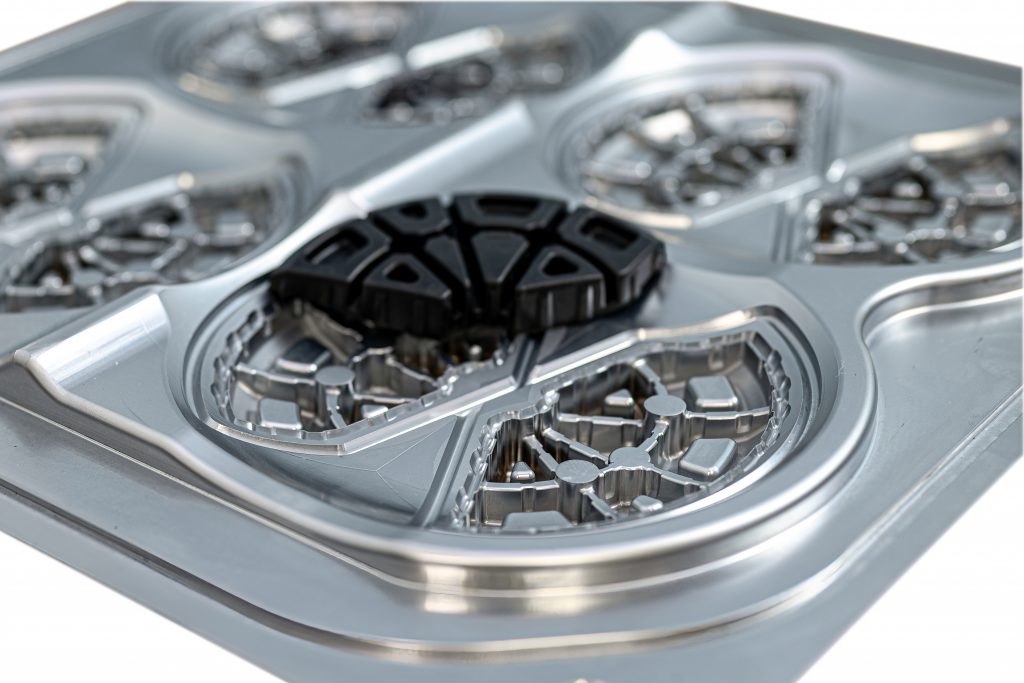
Best practices to adopt
Another essential tool for effective maintenance is a structured checklist, which makes the process clear, repeatable and traceable.
OCS recommends dividing checks into five key areas:
-
Centring check: at the end of the moulding cycle, verify that the last moulded parts have a centring in tolerance. If not, bushings and pins must be replaced immediately. In addition to this operation, OCS also performs a cold inspection by analysing the part and measuring it with dedicated tools.
-
Chrome plating inspection in the injection gate: any colour changes indicate wear of the chrome coating. This phenomenon becomes even more evident when the mould is hot.
-
Dents inspection: the moulder must also check that there are no dents. If there are any, it is advisable to contact the mould maker and not to proceed with the repair in-house.
-
Edge inspection in older moulds: if the mould is particularly old, its edges must be checked. If they are too rounded due to the work, the mouldmaker has to restore them. How do you notice rounded edges? By quality controlling the finished piece.
-
Clean the mould as soon as possible: if you wait too long, the surface will start to corrode.
Tangible benefits
A structured maintenance process delivers immediate and measurable benefits:
-
Cost reduction: less downtime and fewer rejects.
-
Longer mould life: proper maintenance preserves the value of investments.
-
Improved product quality: well-maintained moulds produce articles that are more uniform and compliant with specifications.
-
Maintenance staff training: documentation becomes a living manual for new team members, facilitating knowledge transfer.
Documenting maintenance does not simply mean filling out forms: it means creating a system of prevention, control and continuous improvement. It is an investment that pays off in efficiency, quality and reliability.
Would you like to explore how to best structure your mould maintenance process? Get in touch with us to learn more.

